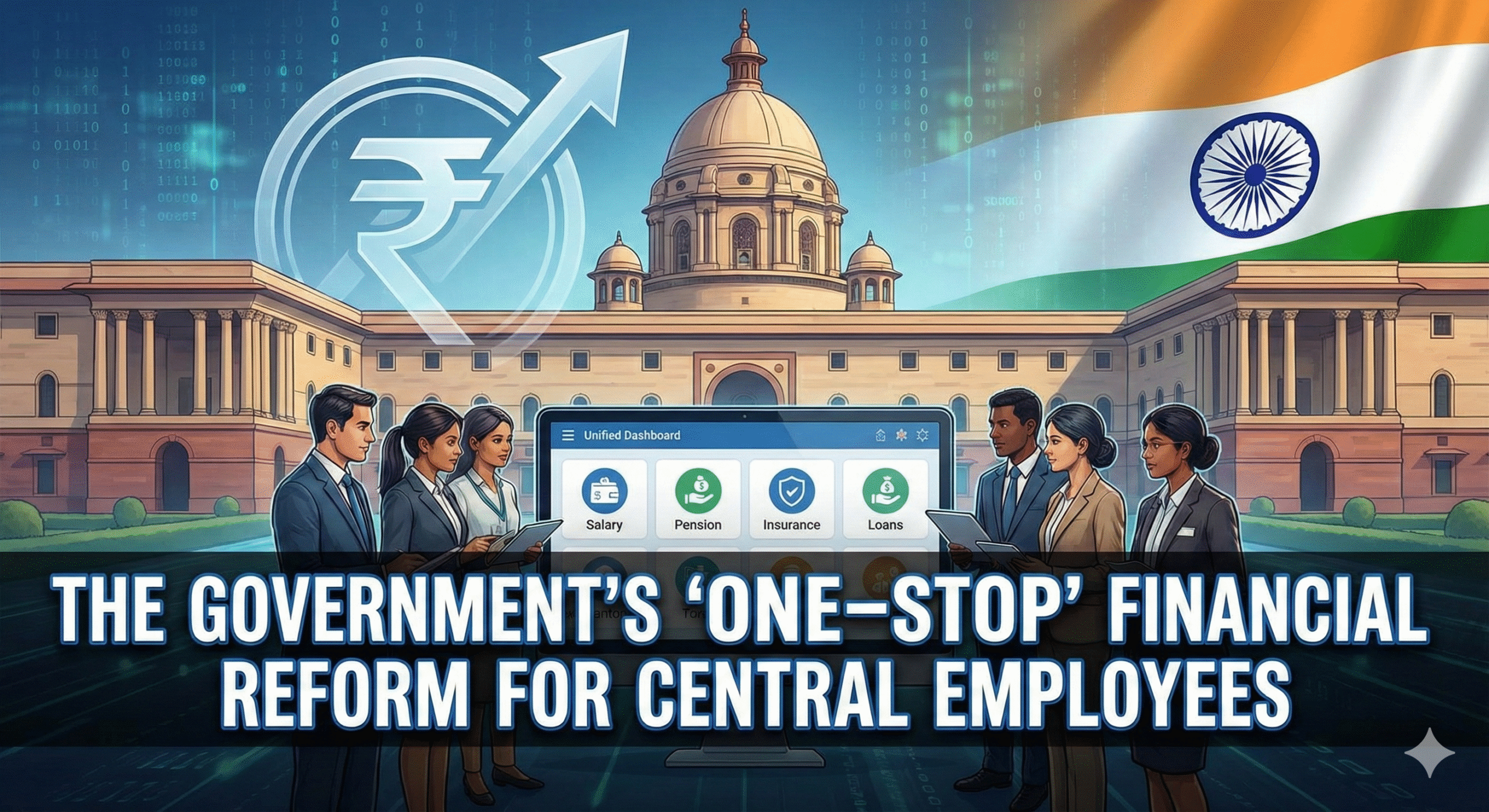

In a significant move to standardize and enhance the financial security of its workforce, the Department of Financial Services (DFS), Ministry of Finance, has officially launched the Composite Salary Account Package . Unveiled by DFS Secretary M. Nagaraju on January 14, 2026, the initiative is designed as a comprehensive welfare measure that integrates banking, insurance, and lifestyle benefits into a single framework for Central Government employees .
Developed in collaboration with Public Sector Banks (PSBs), the package aims to replace fragmented financial services with a unified solution available to employees across all cadres (Groups A, B, and C) .
The Core Proposition: Integration and Uniformity
The primary strategic shift in this initiative is the move toward a “one-stop financial solution” . Previously, employees might have had to seek separate providers for banking, term life, or health top-ups. This package consolidates these needs into three core segments: Banking, Insurance, and Cards .
The government has explicitly aligned this reform with broader national goals, citing the vision of Viksit Bharat 2047 and the commitment to “Insurance for All by 2047” . By embedding insurance directly into salary accounts, the DFS aims to maximize social security coverage automatically.
Key Features Breakdown
The package offers a robust suite of benefits designed to reduce out-of-pocket costs and increase financial protection for employees.
1. Banking Privileges & Cost Savings
The banking component focuses on reducing daily transactional friction and borrowing costs:
- Account Basics: Employees are entitled to a zero-balance salary account with no maintenance charges .
- Transaction Benefits: Unlimited free transactions are provided, including free remittances via RTGS, NEFT, and UPI, as well as cheque facilities .
- Lending & Lockers: A critical financial relief comes in the form of concessional interest rates on major loans (housing, education, vehicle, and personal requirements) and concessions on loan processing charges . Additionally, employees will receive waivers on locker rentals .
2. Enhanced Insurance Safety Net
Perhaps the most aggressive feature of the package is the high-value insurance coverage embedded within the account:
- Accident Coverage: The package includes Personal Accident Insurance of up to Rs. 1.50 crore and Air Accident Insurance of up to Rs. 2 crores .
- Disability Support: It provides Permanent Total & Partial Disability cover up to Rs. 1.50 crore .
- Life & Health: Employees receive in-built term life insurance of up to Rs. 20 lakh, with an option to purchase affordable top-ups . Similarly, comprehensive health insurance is available for self and family, also with top-up facilities .
3. Lifestyle and Digital Perks
To modernize the banking experience, the package includes enhanced benefits on debit and credit cards . These perks include reward programs, cashback offers, and airport lounge access, positioning the government salary account competitively against premium private sector banking products .
Implementation and Access
The rollout strategy relies heavily on the existing network of Public Sector Banks. The DFS has advised these banks to:
- Organize awareness camps within Government Departments .
- Facilitate the migration of existing salary accounts to this new composite package (subject to employee consent) .
- Widely publicize the product details on their official websites .
Conclusion
The launch of the Composite Salary Account Package marks a pivotal shift in how the government manages employee welfare. By leveraging the scale of Public Sector Banks, the Ministry of Finance has effectively negotiated a “group” deal that offers individual employees high-value insurance and concessional lending that would be difficult to secure independently. This initiative not only strengthens the social security net for the public administration workforce but also reinforces the relationship between government employees and the public banking sector .

I am a content writer from India. I specialize in writing the latest news and updates related to government employees, government schemes, and welfare programs. My focus is on delivering accurate, useful, and up-to-date information for readers who follow government-related topics. I contribute content exclusively to this website.
COMMENTS